
EN

Enshrined Deities
御祭神
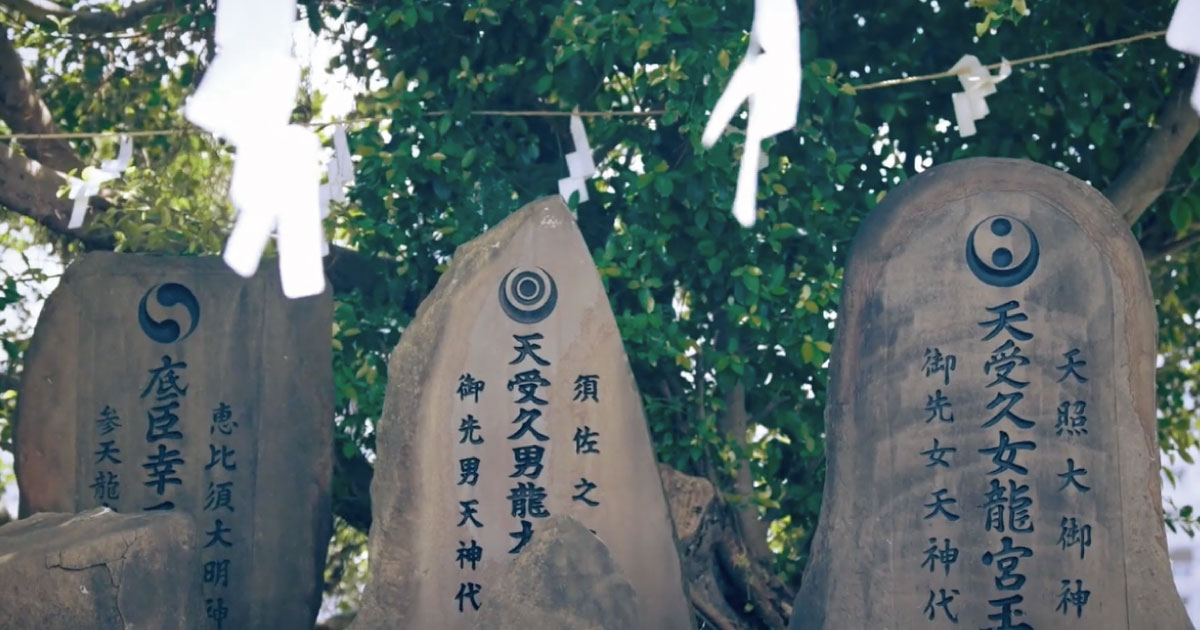
Roots of the Enshrined Deities
The origins of Okinogu begin with the enshrinement of a sacred spirit tree that appeared at Naha Port.
The root source of that spirit tree is said to be Tentozan Utaki on Onoyama. The deity who dwells there is praised in Japanese Shinto as Amaterasu Omikami, and in Okinawan divine names as Tenjukume Ryuguo Ongami.
At Okinogu, Tentozan Utaki serves as the inner sanctuary while the shrine hall serves as the outer worship. Utaki and shrine are enshrined together as one.
The Utaki is the sacred ground where the Divine Age and the age of the kami dwell—the root of all divinity. The shrine is the place of prayer where that divine virtue is honored outwardly.
To understand the enshrined deities of Okinogu, it is essential first to know this principle: the Utaki as root, and the shrine as outer worship.
Creation of Heaven and Earth and the Three Pillars of Divine Light
In the system of enshrined deities at Okinogu, great importance is placed on the divine light that shines from heaven from the very beginning of heaven and earth—the creation of the cosmos.
This divine light is the sacred work of the kami that illuminates, protects, and nurtures life.
At Okinogu, the three heavenly goddesses of the Divine Age are enshrined at the center of the main hall as the central deities expressing this yang divine light.
Misesaki Tenjinndai. Nakatenjinndai. Imatenjinndai.
All three are heavenly goddesses of the Divine Age who express the divine light from heaven.
The first deity to appear, the source of this light, is called Amaterasu Omikami. In Okinawan divine names, we address this deity as Tenjukume Ryuguo Ongami.
Here, yang refers to the work of divine light that shines from heaven, protecting and nurturing life.
The Work of Birth and Expansion on Earth
From the very beginning, yang energy rises to heaven and becomes divine light that illuminates life.
Receiving that divine light, the will of heaven appears on earth, giving birth to life, spreading the land, and nurturing the world.
This is the yin work in the teachings of Okinogu.
Yin does not mean darkness or evil. It is the indispensable work of the kami that receives divine light from heaven, gives form to life, and brings birth and expansion to the earth.
The deities of the First, Second, and Third Divine Ages appear the will of heaven on earth, give birth to and nurture all things in nature, and govern the cycles of direction and time.
At Okinogu, both the yang divine light that shines from heaven and the work of birth and expansion that appears on earth receiving that light are honored together.
The crest of Okinogu consists of the Sacred Sun, Sacred Moon, and Sacred Mirror.
Sacred Sun
The yang divine light that shines from heaven.
Sacred Moon
The yin work that receives that light and brings birth and expansion to life on earth.
Sacred Mirror
A sign that reflects the divine light of heaven and earth and rightly illuminates the human heart and mission.
These Sacred Sun, Moon, and Mirror are treasured as sacred treasures symbolizing the three great divine principles of Okinogu.

Deities of the Main Sanctuary
At the central seat of the main hall, three heavenly goddesses of the Divine Age are enshrined.
Tenjinndai refers to the deities who, in the Divine Age before human birth, shine the divine light from heaven and protect and nurture life.
The three heavenly goddesses are the central deities expressing yang divine light in the system of enshrined deities at Okinogu.
Each is honored as divine light of the source, divine light that bestows wisdom, and divine light that bestows fortune and virtue.
Misesaki Tenjinndai — Central Seat
Tenjukume Ryuguo Ongami
Tenjukume Ryuguo Ongami
Tenjukume Ryuguo Ongami is the deity who dwells at Tentozan Utaki and is the divine light at the root of the enshrined deity system of Okinogu.
In Okinawan divine names this deity is called Tenjukume Ryuguo Ongami; in Japanese Shinto, Amaterasu Omikami.
At Okinogu, the root of the spirit tree that appeared at Naha Port is revered at Tentozan Utaki on Onoyama, and this deity is enshrined as the source of divine light that illuminates, protects, and nurtures life.
The grand spring festival of Okinogu on the twenty-third day of the third month in the old calendar is an important festival day when this divine name was revealed.
Nakatenjinndai — Central Seat
Amachijome Ryuguo Ongami
Amachijome Ryuguo Ongami
Amachijome Ryuguo Ongami is honored as Nakatenjinndai, a deity of divine light.
This deity is said to have descended to Kubo Utaki on Kudaka Island and to dwell at Shinkyoen in Tamagusuku.
Deeply connected with the faith of Higomawari, this deity is enshrined as one who bestows wisdom and the power to live upon the people of the world.
At Okinogu, this deity is honored as divine light that illuminates the path and bestows wisdom.
Imatenjinndai — Central Seat
Tenjukame Ryuguo Ongami
Tenjukame Ryuguo Ongami
Tenjukame Ryuguo Ongami is honored as Imatenjinndai, a deity of divine light.
This deity is said to have descended near Tatchu on Iejima and to dwell behind Bekkan Gongen in Bekkan, Nago.
Deeply connected with the faith of Kuminupari, this deity is enshrined as one who bestows fortune, virtue, and the power of governance and learning.
At Okinogu, this deity is honored as divine light that illuminates the path of prayer in the northern mountains and Kuminupari, bestowing fortune and righteous power.
First Divine Age — Left Side Seat of the Associated Hall
The First Divine Age refers to the deities honored as the first parent deities who appear the will of heaven on earth and bring birth and expansion to life.
At Okinogu, the father deity and mother deity are enshrined at the left side seat of the associated hall.
These parent deities are treasured as deities who receive divine light from heaven, appear on earth, and govern the beginning of the spread of life. In Okinawa, it is said that the grace of the Dragon Palace dwells at the root of human life, and the people have long been honored as inheritors of the divine virtue of the dragon deities.
Tenryu Oongami
Tenryu Oongami
Tenryu Oongami is honored as the father deity.
Enshrined as the source of the grace of the dragon spring and the water deity.
As the father deity who appears the will of heaven on earth and brings birth and expansion to life, this is an important deity in the enshrined deity system of Okinogu.
Amekushin Otome Oongami
Amekushin Otome Oongami
Amekushin Otome Oongami is honored as the mother deity.
Enshrined together with Tenryu Oongami as the parent deities who bring birth and expansion to life on earth.
Also called Konpira Daimyojin, this deity is treasured as the mother deity of birth and expansion.
Heavenly Descent Deities — Right Side Seat of the Associated Hall
At the right side seat of the associated hall, three goddess deities of heavenly descent are enshrined.
These three are honored as mother deities who receive divine light from heaven, appear on earth, spread the land, and nurture the world.
In the enshrined deity system of Okinogu, these mother deities of heavenly descent are treasured as deities who spread the will of heaven to the earth and give form to life.
Tenboshi Otome Oongami
Tenboshi Otome Oongami
Tenboshi Otome Oongami is a mother deity of heavenly descent, also called Amatsukami.
Honored as the deity united with Aminihigodai, this deity is said to dwell on the left hill of Ikeshiro-yama in Onoyama, at Yomochi Shrine.
At Okinogu, this deity is enshrined as the mother deity at the beginning of spreading the land on earth receiving divine light.
Tenjinshi Otome Oongami
Tenjinshi Otome Oongami
Tenjinshi Otome Oongami is a mother deity of heavenly descent, also called Amagawa-no-kami.
Honored as the deity united with Onoyama Hotei Daishu, this deity is said to have descended to Ikeshima and to dwell on Okeshima in Tamagusuku.
Deeply connected with the faith of Higomawari, this deity is enshrined as a mother deity who spreads wisdom and divine virtue to the earth receiving divine light.
Tenraishi Otome Oongami
Tenraishi Otome Oongami
Tenraishi Otome Oongami is a mother deity of heavenly descent, also called Amasoko-no-kami.
Honored as the deity united with Amasoko Bishamonten Daishu, this deity is said to have descended to the land of Kuminupari and to dwell at the ruins of Kuminupari Castle.
Deeply connected with the faith of Kuminupari, this deity is enshrined as a mother deity who spreads fortune, virtue, and protection to the earth receiving divine light.
Three Deities of Kumano — Right Side Seat of the Associated Hall
Okinogu was anciently called Okiyama Sansho Gongen and also Ichiban Gongen of Honshu, preserving a connection with Kumano faith.
At the right side seat of the associated hall, the Three Deities of Kumano are enshrined in accordance with this origin.
The Three Deities of Kumano are deities that express the historical sacred bond Okinogu has inherited since the age of shinbutsu syncretism.
-
Izanagi-no-Mikoto
Izanagi-no-Mikoto
-
Hayatama-no-O-no-Mikoto
Hayatama-no-O-no-Mikoto
-
Kotosaka-no-O-no-Mikoto
Kotosaka-no-O-no-Mikoto
About the Heavenly Twelve Directions
The twelve earthly branches are not merely marks of birth year. They are the twelve directions and twelve gates through which the will of heaven appears on earth, giving birth to and nurturing all things in nature, showing the order of transformation and the cycles of time and season.
At Okinogu, the deities of the Second and Third Divine Ages are enshrined as deities of the Divine Age who guard these twelve gates.
The source of these twelve directions belonging to the Divine Age is called the Heavenly Twelve Directions.
Through these twelve gates, Okinogu teaches that we are protected in birth year, daily cycles, directional guardianship, and the path of life and mission inherited from our ancestors.
Enshrined Deities of Auxiliary Shrine Sumiyoshi — Second Divine Age
At the auxiliary shrine Sumiyoshi of Okinogu, deities of the Second Divine Age are enshrined as divine couples.
The Second Divine Age refers to the three male deities who appeared on earth and their divine spouses, inheriting life from the parent deities of the First Divine Age.
The three deities of the Second Divine Age are honored as the first child deities on earth who appear the will of heaven.
The three deities of the Second Divine Age are also connected with the directions of Rat, Ox, and Tiger.
Rat, Ox, and Tiger are the directions from north toward northeast—the kimon direction—which has long been treasured as the boundary connecting this world and the hidden world (kakuriyo).
Starting from this kimon direction, divine virtue spreads to the deities of the Third Divine Age, and the Heavenly Twelve Directions are arranged.
Deity of Rat — Divine Couple
Amafuryu Ookami
Amafuryu Ookami
Honored as the deity of wind, the first child deity on earth.
Uhashinko Otome Oongami
Uhashinko Otome Oongami
Divine spouse of Amafuryu Ookami. A mother deity connected with the divine virtue of wind, supporting the spread of life.
Deity of Ox — Divine Couple
Amahiryu Ookami
Amahiryu Ookami
Honored as the deity of fire, a child deity inheriting life from the parent deities of the First Divine Age.
Nakashinko Otome Oongami
Nakashinko Otome Oongami
Divine spouse of Amahiryu Ookami. A mother deity connected with the divine virtue of fire, warming and nurturing life.
Deity of Tiger — Divine Couple
Amasui Ryu Ookami
Amasui Ryu Ookami
Honored as the deity of water, a child deity inheriting life from the parent deities of the First Divine Age.
Sokoshinko Otome Oongami
Sokoshinko Otome Oongami
Divine spouse of Amasui Ryu Ookami. A mother deity connected with the divine virtue of water, moistening and nurturing life.
Enshrined Deities of the Third Divine Age
The Third Divine Age refers to the deities born from the divine couples of the Second Divine Age.
When the deities of the Third Divine Age are added to the three deities of Rat, Ox, and Tiger of the Second Divine Age, the guardianship of the twelve directions connected with the twelve earthly branches—the Heavenly Twelve Directions—is complete.
At Okinogu, deities of the Third Divine Age are enshrined at the auxiliary Benzaiten Shrine and the auxiliary Yasaka Shrine.
Auxiliary Shrine Benzaiten — Deity of Dragon
At Benzaiten Shrine within the grounds of Okinogu, Mokuryu Ugushiku Otohimeo is enshrined.
This deity is transmitted as the goddess at the origin of the noro deities who connect the world of the kami and the world of human beings through prayer.
Noro is the word in Okinawa for a sacred priestess who presides over rituals.
Mokuryu Ugushiku Otohimeo
Mokuryu Ugushiku Otohimeo
Also called Bentenyo Hyakutsuhime-no-kami. Transmitted as the divine name of the Dragon deity and the noro deity.
Auxiliary Shrine Yasaka — Enshrined as Divine Couples
At Yasaka Shrine, deities of the Third Divine Age are enshrined as divine couples.
Deities of the Third Divine Age are honored as deities connected with the directions of the twelve earthly branches, guarding all four directions and eight corners.
Deity of Rabbit
Bentenyo Shironookami
Bentenyo Shironookami
Deity of Monkey
Jinten Yabune Hiku Himeno-kami
Jinten Yabune Hiku Himeno-kami
Deity of Horse
Bentenyo Yasuhiko Ookami
Bentenyo Yasuhiko Ookami
Deity of Rooster
Jinten Yabune Kuku Himeno-kami
Jinten Yabune Kuku Himeno-kami
Deity of Goat
Jintenya Shironookami
Jintenya Shironookami
Deity of Boar
Raite Sumé Akekuhi Himeno-kami
Raite Sumé Akekuhi Himeno-kami
Deity of Dog
Raite Sumé Kunochi Ookami
Raite Sumé Kunochi Ookami
Deity of Snake
Bentenyo Kuchihime-no-kami
Bentenyo Kuchihime-no-kami
Enshrined Deities of Gongendo — Earthly Twelve Directions
Gongendo is an important hall that enshrines as the principal image the ancestral deities who protect guardian stars (miboshi) and the path of mission based on the twelve earthly branches, connected with Nirai and Kanai.
At Okinogu, the source of the twelve directions belonging to the Divine Age is called the Heavenly Twelve Directions. The Earthly Twelve Directions that support that mission on earth are called the Earthly Branch Twelve Directions.
Miyo refers to the path of ancestral elders who inherited the work of the kami on earth and guided the people.
Therefore, at Gongendo, we revere guardian stars, human mission, and the connection of the path of life through the twelve earthly branches.
The Earthly Branch Twelve Directions are enshrined in four groups of three combined earthly branches.
These four groups correspond to the combinations called sangou in Onmyodo. Each guardian star resonates with the others, expressing the principle that supports human life and mission.
Whereas the shrine is the place that enshrines deities of the Divine Age, Gongendo is treasured as the place to revere ancestral deities of Miyo.
Misesaki Twelve Branches
Tensoji Miyo
Rat · Dragon · Monkey
Tenteishi Miyo
Ox · Snake · Rooster
Tenshoji Miyo
Tiger · Horse · Dog
Tenbushi Miyo
Rabbit · Goat · Boar
Naka Twelve Branches
Tenshison Miyo
Rat · Dragon · Monkey
Tenobiko Miyo
Ox · Snake · Rooster
Tenaison Miyo
Tiger · Horse · Dog
Tenseishi Miyo
Rabbit · Goat · Boar
Ima Twelve Branches
Tenzonji Miyo
Rat · Dragon · Monkey
Tenshinki Miyo
Ox · Snake · Rooster
Tenhanji Miyo
Tiger · Horse · Dog
Tenjinshi Miyo
Rabbit · Goat · Boar
Ancestral Spirit Hall
The Ancestral Spirit Hall enshrines the sacred names of missions fulfilled by ancestors through the generations and honors their achievements.
It enshrines the spirit tablets of the ancestors of the Great Amaushi, Elder Officials, and Iebe Officials, as well as the spirit tablet of all spirits in the three realms, with or without direct connection.
At Okinogu, the Divine Age, Miyo, and ancestors are each honored according to their role.
The Divine Age at the shrine. Miyo at Gongendo. Ancestors at the Ancestral Spirit Hall.
By treasuring this order, it is taught that we can rightly revere the grace of the kami, the ancestral deities of Miyo, and the achievements of ancestors through the generations.
Knowing the Enshrined Deities, Walking the Path of Prayer
To know the enshrined deities of Okinogu is not merely to memorize the names of the kami.
It is to know the flow by which life took form through yang light and yin work, and prayer of the kami was inherited on earth through the ages of Misesaki, Naka, and Ima.
By touching the root of that prayer, we can reflect anew on what to revere, what to set in order, and how to live in daily life.
At Okinogu, this path of prayer and reverence is transmitted as Okinawado.


